
We all know the importance of trees. From a young age, we are taught that forests are the “lungs of the earth.” They are iconic symbols of nature, and protecting them is rightly a global priority. But while our eyes are fixed on the canopy, we are losing the ground beneath our feet.
Recent data from the Ramsar Convention reveals a startling truth: Wetlands are disappearing three times faster than forests.
This statistic isn’t meant to diminish the value of woodlands. We need our forests more than ever. However, it highlights a dangerous gap in our collective knowledge. While forests have captured the public imagination, wetlands have suffered from an image problem. They are often viewed as boggy wastelands rather than the high-performance ecosystems they actually are.
To truly tackle the climate crisis, we need a “systems thinking” approach that values both the lungs and the kidneys of our planet. Here is why wetlands deserve equal standing in the conservation conversation.
1. The Carbon Vault (Complementing the Carbon Sink)
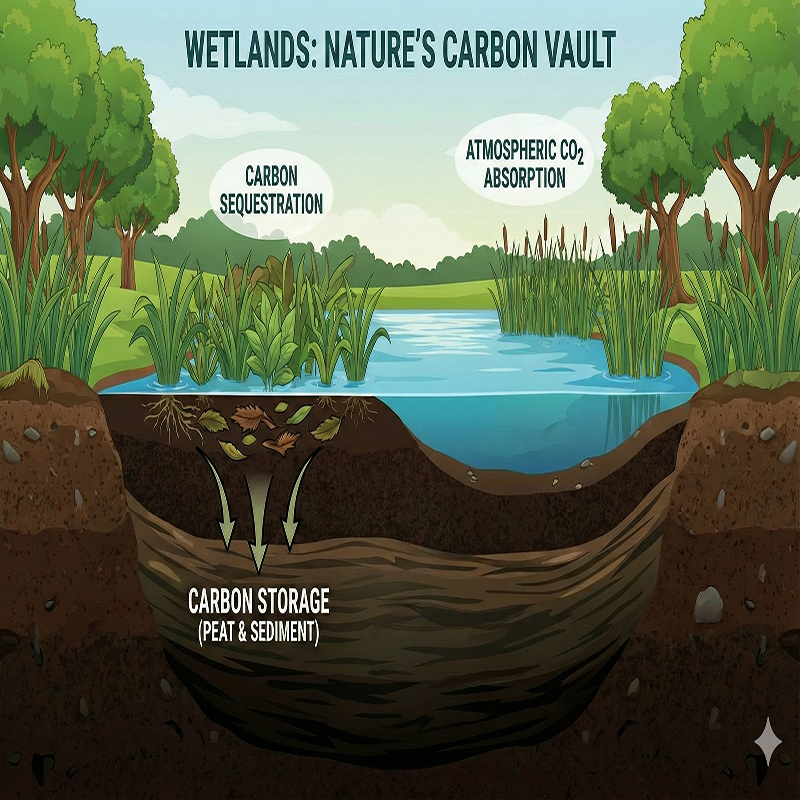
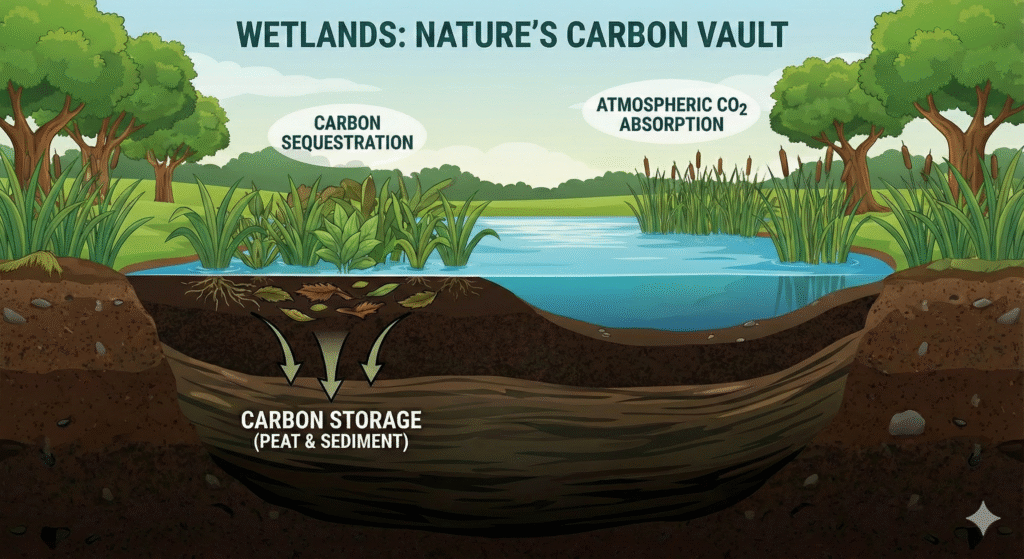
Forests are incredible at sequestering carbon as they grow. But wetlands, particularly peatlands, function differently. They are carbon vaults.
Peatlands cover only about 3% of the world’s land surface, yet they store twice as much carbon as all the world’s forests combined. Because wetlands are waterlogged, organic matter doesn’t decay and release carbon dioxide the way it does on dry land. Instead, it accumulates over millennia. When we drain wetlands for agriculture or development, we aren’t just stopping a sink. We are unlocking a vault and releasing thousands of years of stored carbon back into the atmosphere in a matter of decades.
2. The “Kidneys” of the Landscape
If forests are the lungs that help us breathe, wetlands are the kidneys that keep the system clean.
Water quality is a growing crisis globally. Wetlands act as natural filtration plants. As water moves slowly through a marsh or swamp, sediments settle out, and plants absorb excess nutrients like nitrogen and phosphorus from agricultural runoff. Without healthy wetlands, our rivers and lakes become choked with algae and pollutants. This threatens both human health and aquatic life.
3. Resilience Against Extreme Weather
Climate change isn’t just about warming. It is about water. We are facing a future with either too much of it or too little. In this regard, wetlands are our best infrastructure.
- During Floods: Wetlands act as giant sponges. They absorb heavy rainfall and storm surges by holding the water and releasing it slowly. This naturally lowers flood heights and protects downstream communities.
- During Droughts: That same stored water is gradually released into the soil and aquifers. This keeps streams flowing even when the rain stops.
Forests stabilize the soil, but wetlands stabilize the flow. We need both to weather the storms ahead.
4. A Hub for Biodiversity
Wetlands are among the most productive environments on earth. It is estimated that 40% of all the world’s plant and animal species live or breed in wetlands.
They serve as critical nurseries for fish, stopovers for migratory birds, and homes for countless amphibians. When we lose a wetland, we aren’t just losing water. We are erasing a complex web of life that cannot be easily replaced.
Bridging the Knowledge Gap
The loss of 35% of our wetlands since 1970 is not just an environmental failure. It is a failure of knowledge transfer. The science on wetlands is clear, yet policy and public perception lag behind.
At K2 Action, we believe that transferring knowledge is the first step toward action. We cannot protect what we do not understand. We need to translate the complex science of wetland ecosystem services into clear, actionable insights for policymakers, developers, and the public.
Saving our wetlands doesn’t mean ignoring our forests. It means recognizing that a healthy planet requires a diverse portfolio of ecosystems. It is time we fought for the swamp just as hard as we fight for the forest.